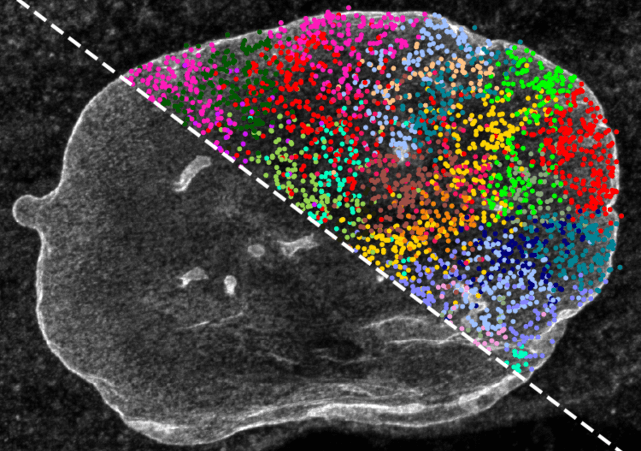
Broad Institute and Harvard Department of Stem Cell and Regenerative Biology researchers have developed a technology that provides new insight into how disruptions in the nucleus of the cell can impact health and disease.
The approach, called expansion in situ genome sequencing, allows scientists to sequence DNA and map its location relative to proteins within cell nuclei. The method uses a gel to expand cells while keeping them intact, enabling both sequencing and high-resolution imaging within the same cells. The research team applied their technique to cells from patients with progeria, a disorder marked by accelerated aging. The scientists found that mutated proteins in the nucleus may suppress the expression of certain genes, which may play a role in the disease and the aging process.
The researchers suggest that these types of changes in the cell nucleus could be at the root of other diseases, and can now be studied in greater detail using their new method.
The findings appear today in Science and come from the labs of institute member Jason Buenrostro and core institute member Fei Chen at the Broad. Buenrostro and Chen are also associate professors in Harvard’s Department of Stem Cell and Regenerative Biology, and Buenrostro is a co-leader of Broad’s Gene Regulation Observatory.
“With this work we can now sequence the genomes of cells directly within cells,” said Buenrostro. “This has inspired us to dream up new biological questions connecting genome structure to function.”
This article is adapted from a Broad Institute story by Allessandra DiCorato.